_edited_edited_edited.png)
Neelam (Blue Sapphire) for Saturn
- Nirmal Nawarathna
- Jul 22
- 3 min read


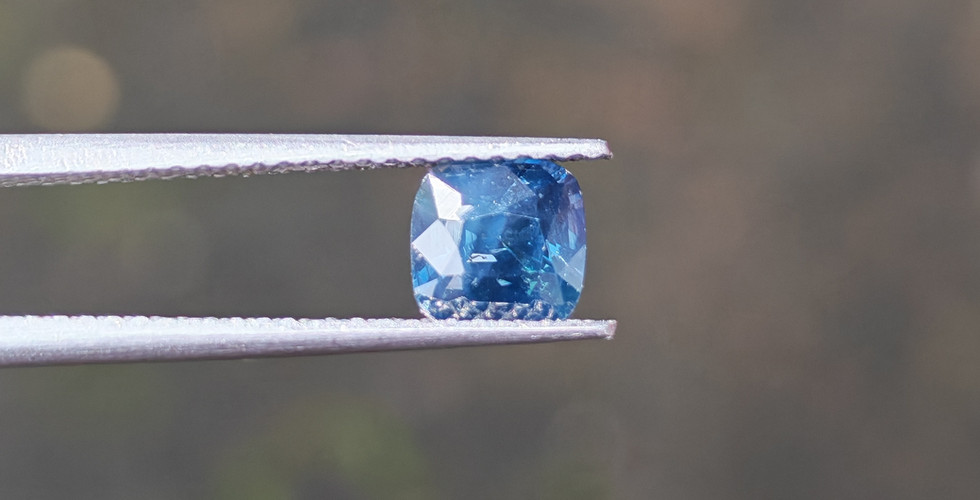


The stone of Shani
In Vedic astrology, blue sapphire — Neelam — is the ratna of Saturn (Shani), the planet of discipline, karma, structure and time. It is regarded as the fastest-acting and the most exacting of the nine planetary gemstones. Where Saturn governs a favourable house in the birth chart, a well-chosen Neelam is said to steady the wearer through difficult transits; where the chart cannot support it, tradition counsels caution. This is why Neelam is never a stone to self-prescribe.
Who considers Neelam
Classical practice associates Neelam most closely with Capricorn (Makara) and Aquarius (Kumbha) ascendants, both ruled by Saturn, and often with Taurus and Libra ascendants, ruled by Venus, a friend of Saturn. It is also considered during Sade Sati — the seven-and-a-half-year Saturn passage, so named because Saturn spends roughly two and a half years each in the sign before, the sign of, and the sign after the natal Moon — and during a Shani Mahadasha. A qualified jyotishi reads Saturn's house, sign and strength before recommending it. No general rule replaces that reading.
The wearing details
Planet: Saturn (Shani)
Day: Saturday, in the morning after sunrise, ideally during Shani Hora
Finger: the middle finger of the working hand, associated with Saturn
Metal: silver, white gold, or panchdhatu; gold is generally avoided because it is ruled by the Sun, considered inimical to Saturn
Mantra: the Saturn mantra "Om Sham Shanaischaraya Namah," recited 108 times; some practitioners use the longer beej mantra "Om Praam Preem Praum Sah Shanaischaraya Namah"
Many astrologers advise a short trial — wearing or keeping the stone in contact for a few days before committing to it permanently — a caution drawn from classical texts that treat Neelam as powerful enough to warrant observation.
Ratti and weight
Jyotish weight is traditionally measured in Ratti. One Ratti is approximately 0.91 carats, so a commonly prescribed 5.25 Ratti stone is roughly 4.8 carats. A widely used guideline is around one Ratti for every ten to twelve kilograms of body weight, though your astrologer's specific figure takes precedence. Most jyotish practitioners look for a minimum of two carats for meaningful influence. PMKK GEMSDatabazaar
Why unheated matters here
The majority of sapphires in the trade are heat-treated to deepen colour and clear silk. In jyotish tradition, only a natural, untreated stone is held to carry the planet's unmodified energy — heating is believed to disturb it. Whatever one's view of the metaphysics, the practical consequence is clear: a jyotish buyer needs documentary proof that a stone is unheated, and that proof comes only from a gemmological laboratory report. ShubhGemsDatabazaar
The setting
For astrological purposes the stone should touch the skin, which is why an open-base (open-back) setting is used — the pavilion of the gem sits against the finger rather than being sealed in metal. Dhaneera can supply loose Neelam ready for a jyotishi's prescribed open-base ring, with optional Sanskrit engraving. Databazaar
A closing note
Every Neelam we offer is a natural Ceylon sapphire from Ratnapura, predominantly unheated, and certified by an independent GIA-affiliated laboratory in Sri Lanka. Each stone travels with an NFC Gem Story Card recording its origin and its report. If a stone is not right for you, our thirty-day return applies. [Internal link: browse certified blue sapphires] · [Internal link: Heated vs Unheated — and how to read the certificate]
Comments